- Why a Checklist Matters Before You Start
- The 12 Questions
- 1. What specific business problem are you trying to solve?
- 2. Do you have the data this AI system will need?
- 3. How complete and accurate is that data?
- 4. Who owns the data, and can they grant access?
- 5. Do you have the technical infrastructure to support AI?
- 6. Does your team have the skills to work with AI tools?
- 7. Is leadership aligned on what success looks like?
- 8. Have you mapped the process this AI will affect?
- 9. What are the risks if the AI gets it wrong?
- 10. Do you have a governance framework for AI use?
- 11. What does the change management plan look like?
- 12. How will you measure whether it's working?
- What to Do With Your Answers
- The Dimensions Behind These Questions
- A Note on Timing
- FAQs
- Start With Clarity
Most AI projects don't fail because the technology is wrong. They fail because the business wasn't ready for it.
Before you spend time, money, or goodwill on an AI initiative, you need an honest picture of where your organisation actually stands. Not where you hope it stands. Not where a vendor's pitch deck suggests it should be. Where it actually is.
These 12 questions cover the dimensions that most commonly determine whether an AI rollout succeeds or stalls: data, people, process, governance, and strategy. Work through them honestly and you'll have a much clearer sense of what to tackle first.
Why a Checklist Matters Before You Start
Skipping this step is expensive. Teams buy tools they can't integrate, hire consultants to fix problems that were entirely predictable, or launch pilots that collapse because no one owns the data they depend on.
A structured AI readiness checklist forces those gaps to the surface before they become costly. It also gives your team a shared language, so conversations about AI adoption are grounded in specifics rather than enthusiasm.
The 12 Questions
1. What specific business problem are you trying to solve?
This sounds obvious, but many AI projects start with the technology and work backwards. If you can't describe the problem in one or two plain sentences, the project isn't ready to start. Vague goals produce vague results.
2. Do you have the data this AI system will need?
AI is only as good as the data it runs on. Does this data exist in your organisation? Is it digital, accessible, and reasonably clean? If the answer to any of those is "not really," that's your first project — not the AI itself.
3. How complete and accurate is that data?
Even if the data exists, quality matters. Incomplete records, inconsistent formats, and outdated entries can make a model unreliable or actively misleading. Audit a sample before assuming it's usable.
4. Who owns the data, and can they grant access?
Data ownership inside organisations is often messier than it looks. What you need might sit across three departments, each with different systems and different views on sharing. Identify the owners now and confirm access is possible before you build anything around it.
5. Do you have the technical infrastructure to support AI?
This doesn't mean you need a data science team. It means asking whether your current systems, cloud setup, and integration capabilities can support the tools you're considering. A business running everything on spreadsheets and a legacy CRM faces different constraints than one already on cloud-based platforms.
6. Does your team have the skills to work with AI tools?
You don't need engineers to use AI effectively, but you do need people who understand what the tool is doing, can spot errors, and know when to trust the output. Assess the current skill level honestly. Is the gap trainable, or do you need to hire or partner?
7. Is leadership aligned on what success looks like?
AI projects without clear executive sponsorship tend to lose momentum when they hit friction — and they always hit friction. Before starting, confirm that the people with budget and authority understand the goal, have agreed on how success will be measured, and are prepared to support the project through its difficult middle stages.
8. Have you mapped the process this AI will affect?
AI works best when it's embedded into a well-understood workflow. If the process it's meant to improve is poorly documented or inconsistently followed, the AI will amplify that inconsistency. Map the process first. Identify the steps, the decision points, and where human judgment still needs to stay.
9. What are the risks if the AI gets it wrong?
Every AI system makes mistakes. The question is what happens when it does. In some contexts, an error is a minor inconvenience. In others, it affects a customer, a compliance obligation, or a safety-critical decision. Know your risk profile before you deploy.
10. Do you have a governance framework for AI use?
Governance doesn't have to be complicated, but it does have to exist. Who monitors the AI's outputs? Who can override it? What happens when something goes wrong? If you can't answer those questions, you're not ready to deploy — regardless of how good the technology is. Organisations with significant governance gaps often benefit from working with specialists before going live.
11. What does the change management plan look like?
The people using this tool every day need to understand why it's being introduced, how it affects their work, and what support is available. Resistance to AI adoption is rarely about the technology. It's about uncertainty. A clear communication and training plan reduces that friction significantly.
12. How will you measure whether it’s working?
Define your success metrics before you start, not after. That might be time saved on a specific task, a reduction in error rates, faster customer response times, or something else entirely. Without a baseline and a clear measure, you won't know whether the project delivered value or just created noise.
What to Do With Your Answers
Working through these questions will likely surface a mix of strengths and gaps. That's normal. Very few small or medium businesses are uniformly ready across every dimension.
The goal isn't a perfect score before you start. It's knowing which gaps are manageable and which ones will sink the project if left unaddressed.
If you want a more structured, scored view of where your business stands, AI Ready Score takes you through 53 to 61 questions across eight business dimensions and immediately emails you a personalised report. It includes an AI readiness score, estimated investment range, risk profile, and a 90-day improvement roadmap — built specifically for small and medium businesses that want clarity without paying for expensive consultants.
The Dimensions Behind These Questions
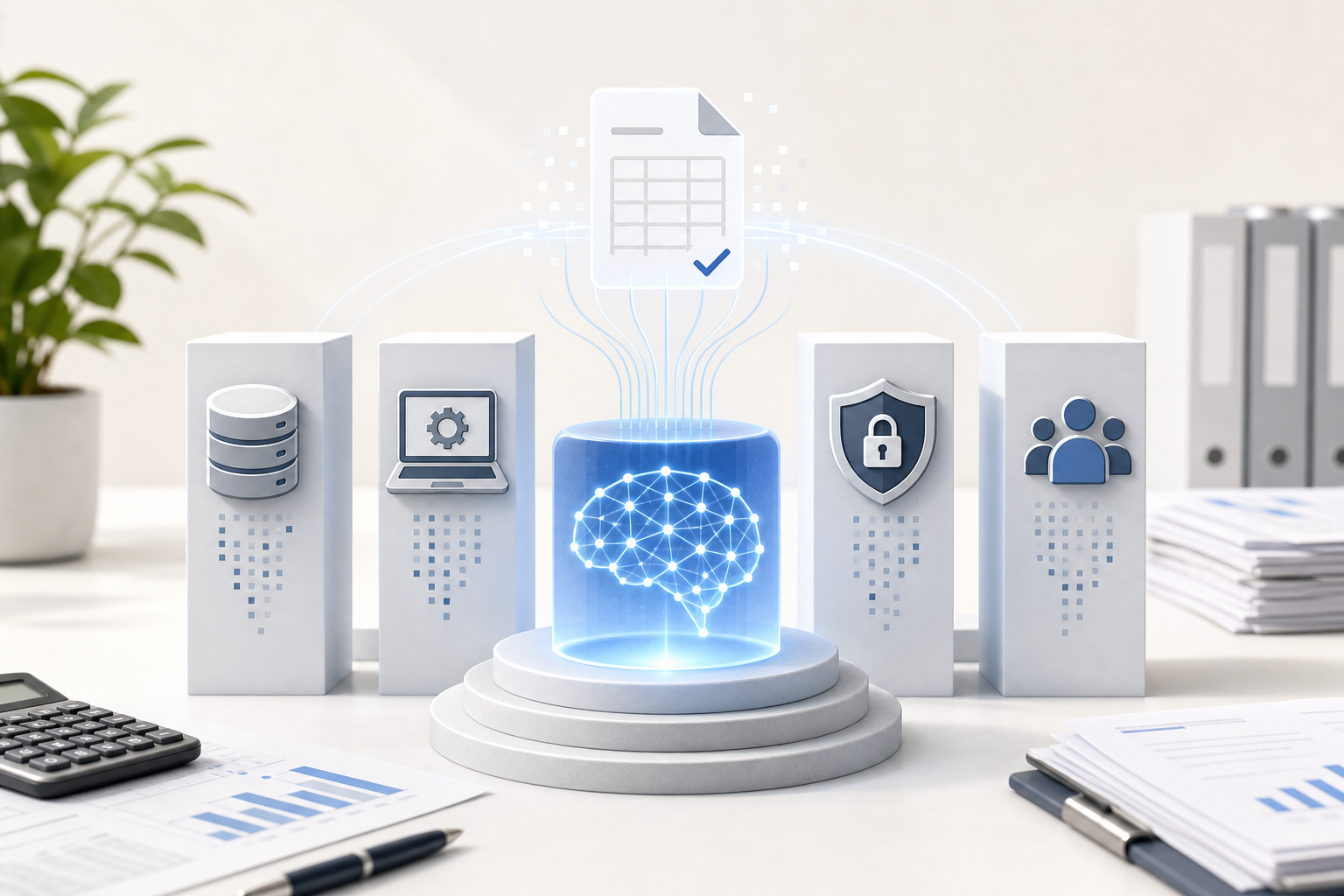
These 12 questions map to the areas that consistently determine AI project outcomes:
- Data infrastructure (questions 2, 3, 4): The foundation everything else depends on
- Technical environment (question 5): What your systems can actually support
- People and skills (questions 6, 11): Whether your team can use and trust the tools
- Strategy and leadership (questions 1, 7): Whether there's clear direction and ownership
- Process clarity (question 8): Whether the workflow is ready to support automation
- Risk and governance (questions 9, 10): Whether you're protected when things go wrong
- Measurement (question 12): Whether you'll know if it worked
Most AI readiness failures trace back to one or two of these areas being significantly weaker than the rest. Identifying which ones before you start is the entire point of this exercise.
A Note on Timing
You don't need to resolve every gap before starting. Some are best addressed in parallel with a small, low-risk pilot. Others genuinely need to be fixed first.
Data quality, ownership, and governance tend to be the ones that can't be deferred. If you don't have the data, can't access it, or have no plan for when the AI makes a mistake, those are blockers. Everything else is a matter of degree.
Start with the questions where your answers are weakest. That's your roadmap.
FAQs
What is an AI readiness checklist?
An AI readiness checklist is a structured set of questions that helps a business assess whether it has the data, infrastructure, skills, processes, and governance in place to successfully adopt AI. It's used before starting an AI project to identify gaps and prioritise what needs to be addressed first.
How do I know if my business is ready for AI?
Readiness isn't binary. Most businesses are ready in some areas and not in others. The key indicators are accessible and reasonably clean data, a clear problem to solve, some level of technical infrastructure, leadership alignment, and a basic governance plan. A structured assessment tool can give you a scored view across all of these dimensions.
Can small businesses use an AI readiness checklist?
Yes — and it's especially useful for smaller businesses without dedicated IT or data science teams. Without that internal expertise, a checklist surfaces the practical questions that would otherwise only come up once a project is already in trouble.
How long does an AI readiness assessment take?
A self-serve assessment like the one at AI Ready Score takes around 10 to 15 minutes. A consultant-led assessment can take days or weeks depending on scope. For most small and medium businesses, a structured self-assessment is a practical first step before deciding whether deeper external support is needed.
What should I do if my AI readiness score is low?
A low score means you have identifiable gaps — which is useful information. Prioritise the areas most likely to block your specific project. Data quality and governance gaps tend to be the most important to address early. A 90-day improvement roadmap, like the one included in the AI Ready Score report, gives you a sequenced plan rather than an overwhelming list.
Do I need to complete all 12 questions before starting an AI project?
You should at least have thought through all 12, even if some answers are incomplete. The questions around data access, risk, and governance are where gaps are most likely to cause serious problems. The others can sometimes be addressed in parallel with a carefully scoped pilot.
What's the difference between AI readiness and digital transformation readiness?
Digital transformation is broader — it covers moving processes online, adopting cloud tools, and improving general technology use. AI readiness is more specific: it focuses on whether your data, people, processes, and governance can support AI-driven decision-making or automation. A business can be digitally mature and still not ready for AI if, for example, its data is siloed or its team lacks the skills to interpret model outputs.
Start With Clarity
The businesses that get the most from AI aren't necessarily the most technically sophisticated. They're the ones that started with an honest assessment of where they stood, fixed the right things first, and set clear expectations before they began.
These 12 questions won't take long to work through. But the answers will tell you more about your project's chances of success than almost anything else you could do before starting.



0 Comments